Particle (Basic ㊦ 312)
A particle which, with a preceding noun phrase, forms a phrase to modify a following noun phrase.
Equivalent: ‘s; of; in; at; for; by; from
| (i) Noun の Noun | 田中さんの家 | Mr. Tanaka’s house |
| アメリカの大学 | A university in America | |
| (ii) Noun Particle の Noun | 日本での仕事 | A job in Japan |
| メアリーへのプレゼント | A present for Mary |
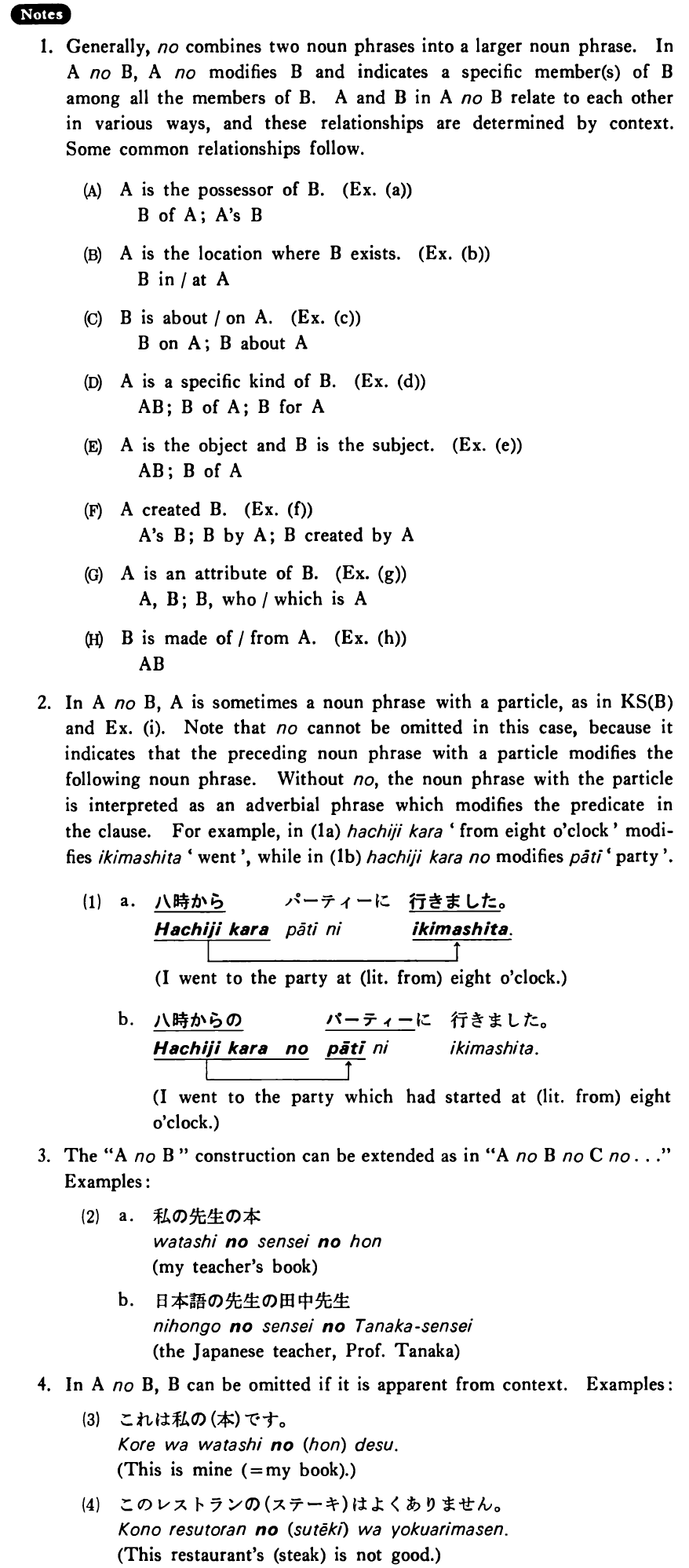
1. Generally, の combines two noun phrases into a larger noun phrase. In AのB, Aの modifies B and indicates a specific member(s) of B among all the members of B. A and B in AのB relate to each other in various ways, and these relationships are determined by context. Some common relationships follow.
2. In AのB, A is sometimes a noun phrase with a particle, as in Key Sentence (B) and Example (i). Note that の cannot be omitted in this case, because it indicates that the preceding noun phrase with a particle modifies the following noun phrase. Without の, the noun phrase with the particle is interpreted as an adverbial phrase which modifies the predicate in the clause. For example, in (1a) 八時から 'from eight o'clock' modifies 行きました 'went', while in (1b) 八時からの modifies パーティー 'party'.
| a. 八時から ⎪ パーティーに ⎪ 行きました。 |
| ↑____________________↑ |
| I went to the party at (literally: from) eight o'clock. |
| b. 八時からの ⎪ パーティーに ⎪ 行きました。 |
| ↑___________↑ |
| I went to the party which had started (literally: from) eight o'clock. |
3. The "AのB" construction can be extended as in "AのBのCの..." Examples:
4. In AのB, B can be omitted if it is apparent from context. Examples: